
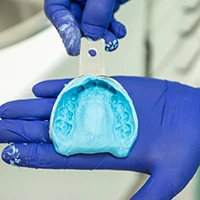
Dental impressions remain an important part of many everyday procedures, from diagnostic models and orthodontic applications to crowns, bridges, implants, and other restorative work. While taking an impression may be routine, choosing the right material can have a significant impact on accuracy, handling, patient comfort, and the overall clinical workflow.
With several types of impression materials available, understanding what makes each one different can help dental professionals choose an option that fits the procedure and the practice.
What Are Dental Impression Materials?
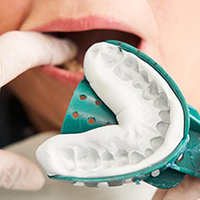
Dental impression materials are used to create a negative reproduction of a patient's teeth and surrounding oral structures. The resulting impression can then be used to create a model or record that supports diagnosis, treatment planning, restorative procedures, orthodontic work, and laboratory fabrication.
Different materials are designed with different properties, including accuracy, working time, setting time, flexibility, dimensional stability, and moisture tolerance. There isn't one material that is ideal for every situation, so selecting the right option starts with understanding what the impression needs to accomplish.
Common Types of Dental Impression Materials
Alginate
Alginate is a familiar choice in many dental practices and is commonly used when a preliminary or diagnostic impression is needed.
Typical applications include:
- Preliminary impressions
- Study and diagnostic models
- Orthodontic models
- Opposing arch impressions
- Certain custom tray procedures
One of alginate's biggest advantages is its simplicity. It can be mixed and prepared relatively quickly, is generally economical, and is available in different setting times to accommodate different workflows.
Alginate does have limitations. Because of its sensitivity to moisture changes after setting, impressions should be handled and poured according to the manufacturer's recommendations to help maintain dimensional accuracy.
VPS (Vinyl Polysiloxane)
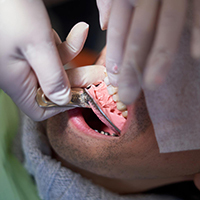
Vinyl polysiloxane, commonly called VPS or addition silicone, is widely used when accurate reproduction of fine detail is important.
VPS is commonly used for:
- Crown and bridge impressions
- Implant impressions
- Inlays and onlays
- Detailed restorative impressions
- Bite registrations
VPS materials are available in different viscosities, allowing clinicians to select materials based on the impression technique and the level of detail required. Light-body materials can be used around prepared areas to capture fine detail, while heavier materials provide additional body and support in the tray.
Dimensional stability is another important characteristic of VPS, particularly when the impression may not be poured immediately.
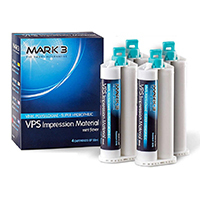
DDS currently carries VPS options ranging from wash materials to medium-body materials, including Take 1 Advanced and MARK3 products.
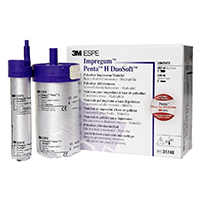
Polyether, Rubber Base & Silicone Materials
Polyether and other elastomeric impression materials are used when accuracy and detailed reproduction are important. Their handling characteristics differ from silicone-based materials, so clinician preference and the requirements of the procedure often play a role in selection.
These materials may be considered for:
- Crown and bridge impressions
- Implant impressions
- Multiple-unit restorative cases
- Other procedures requiring detailed impressions
Polyether is known for its ability to reproduce fine detail and its relatively hydrophilic characteristics. It also tends to be more rigid after setting than many silicone materials, which can be beneficial in some situations but is worth considering when removing an impression from areas with significant undercuts.
The broader DDS category includes polyether, rubber base, and silicone materials, giving practices options beyond traditional alginate and VPS.
Hydrocolloid and Impression Compound
Not every impression starts with an elastomeric material. Hydrocolloid materials and impression compounds also have specific applications within dental and laboratory workflows.
Impression compound, for example, can be used in procedures where a moldable material is needed to help form or modify an impression. Hydrocolloid materials may also be selected for particular preliminary or duplication applications.
These materials tend to be more specialized than the everyday alginate and VPS choices, making it especially important to follow the manufacturer's directions and consider the intended application when selecting them.
Bite Registration Materials
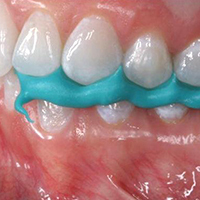
Bite registration materials serve a different purpose from traditional impression materials. Rather than reproducing the entire dentition, they are used to record the relationship between the upper and lower arches.
They may be used for:
- Crown and bridge cases
- Multiple-unit restorations
- Occlusal analysis
- Articulator mounting
- Implant restorations
VPS is also commonly used for bite registration, but dedicated bite-registration materials are formulated specifically for recording the occlusal relationship and maintaining that record during the laboratory process.
DDS carries dedicated bite registration materials as well as bite trays and accessories.
What Should You Consider When Choosing an Impression Material?
The best material isn't necessarily the most advanced or the most expensive. It is the one whose properties make sense for the procedure.
Accuracy and Detail
For procedures involving prepared teeth, margins, implants, or other areas where fine detail matters, choose a material designed to provide the level of accuracy the case requires.
Working and Setting Time
Consider how much time is needed to mix, load, seat, and remove the impression. A shorter setting time may be helpful for efficiency, while a longer working time can provide additional flexibility for more involved procedures.
Moisture Control
Moisture can affect impression quality, so proper isolation and tissue management remain important. Some materials are designed to perform more favorably in the presence of moisture, but no material eliminates the need for good clinical technique.
Dimensional Stability
If an impression cannot be poured immediately, dimensional stability becomes an important consideration. Materials with greater dimensional stability can provide additional flexibility within the clinical and laboratory workflow.
Patient Comfort
The patient's experience matters, too. Setting time, material consistency, tray size, taste, and the amount of time the tray remains in the mouth can all influence comfort.
For patients with a strong gag reflex, for example, minimizing unnecessary impression time may be an important consideration.
Handling and Workflow
A material can have excellent technical properties and still not be the right fit for every practice. Mixing method, dispensing system, working time, cleanup, and compatibility with existing equipment can all influence how easily a material fits into the team's routine.
DDS carries not only impression materials but also disposable trays, impression syringes and accessories, mixing units, and mixing tips to support different impression workflows.
A Quick Guide to Impression Material Selection
| Clinical Need | Material to Consider |
|---|---|
| Preliminary or study impressions | Alginate |
| Orthodontic or diagnostic models | Alginate |
| Detailed crown and bridge impressions | VPS or polyether |
| Implant impressions | VPS or polyether |
| Multiple-unit restorative cases | VPS or polyether |
| Recording the occlusal relationship | Bite registration material |
| Specialized impression or laboratory applications | Hydrocolloid, impression compound, or other appropriate material |
This is a general guide rather than a substitute for the manufacturer's instructions or the clinician's judgment. Individual materials within the same category can have significantly different properties and recommended applications.
The Right Impression Material Starts With the Procedure
Choosing an impression material doesn't have to be complicated. Start with the procedure, determine the level of detail and accuracy required, and then consider the material's working characteristics, moisture tolerance, dimensional stability, and handling requirements.
For routine diagnostic work, alginate may offer a practical and efficient option. More demanding restorative and implant cases may call for an elastomeric material such as VPS or polyether. And when the goal is to accurately capture the relationship between the arches, a dedicated bite registration material may be the better choice.
Taking a few moments to match the material to the task can help make the impression process more predictable for both the dental team and the patient.
DDS Dental Supplies offers a variety of impression materials, trays, accessories, and related products to support different clinical and laboratory workflows. Whether a practice is looking for a dependable material for routine impressions or a specialized option for a more detailed case, understanding the differences between materials is a good place to start.